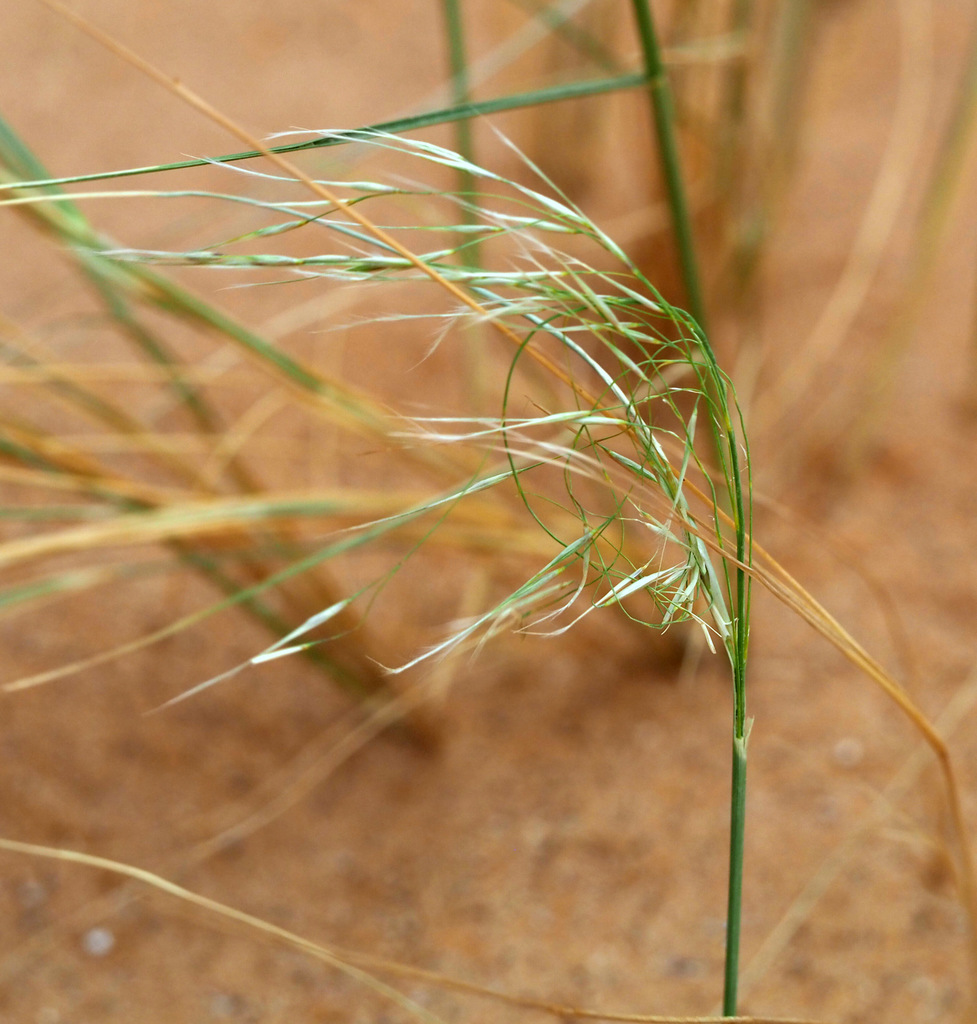
Quick facts
| Arabic name | السبط |
|---|---|
| English name | Sabat (Drar’s Grass) |
| Scientific name | Stipagrostis drarii |
| Family | Grass family (Poaceae) |
| Plant type | Perennial desert grass |
| Height | About 50 cm to 1 m |
| Water use | Low |
Planting and harvest calendar
Best time to plant
October to December
It grows by itself after rain Harvest
Not harvested
JanuaryFebruaryMarchAprilMayJuneJulyAugustSeptemberOctoberNovemberDecember
Planting timeHarvest or flowering
Times are general for the Saudi climate and may shift a few weeks by region: cooler in the highlands and the north, warmer on the coasts and in the south.
Description
A strong grass in dense tufts with stiff stems and thin rolled leaves. Dense white feathery flower heads appear on top.
Where it grows
Grows on sand dunes and sandy plains.
Soil
Sandy soil.
Water and irrigation
Lives on rain.
Climate and light
Handles heat and drought.
Propagation
By seed.
Benefits and uses
- Important grazing for camels and sheep
- Holds sand with dense roots
- A sign of healthy rangeland
- Handles drought
Drawbacks
- Declines with overgrazing
- Seeds can stick in wool
- Not suited to gardens
Important notes
Do not confuse it with Nasi (Stipagrostis plumosa), which has its own page on the site.
Sources and references
The information was collected and checked from these scientific sources:
- Plants of the World Online (POWO) - Royal Botanic Gardens, Kew: Stipagrostis drarii
- Global Biodiversity Information Facility (GBIF): Stipagrostis drarii
- Chaudhary, S. A. (1999-2001). Flora of the Kingdom of Saudi Arabia. Ministry of Agriculture and Water, Riyadh.
- National Center for Vegetation Cover Development and Combating Desertification (NCVC)